



A California revocable living trust is the foundation of a sound estate plan for most homeowners in San Diego County and throughout the state. If you own a home, investment accounts, or other assets that exceed California’s $208,850 probate threshold (Probate Code Section 13100, effective April 1, 2025), your family may face a 12 to 18 month court process, statutory fees of 4% to 7% of your estate’s gross value, and a public record that anyone can access.
At Opelon LLP in Carlsbad, California, our estate planning attorneys have helped hundreds of families create revocable living trusts that protect their assets, maintain privacy, and provide clear instructions for their loved ones. This guide walks you through the seven critical steps to protect your family, explains how California’s community property rules create unique tax advantages, and answers the questions we hear most often from clients across San Diego County.
Key Takeaways |
• A California revocable living trust allows you to maintain full control of your assets while alive and transfer them to beneficiaries without probate. • California probate for a $1 million estate costs approximately $46,000 in combined statutory fees under Probate Code Sections 10800 and 10810. • Funding the trust by retitling assets into the trust’s name is the step most families skip, and it is the step that makes the trust work. • California’s community property rules give married couples a valuable double step-up in basis that can eliminate capital gains tax on appreciated assets. • Opelon LLP in Carlsbad, California offers flat-fee estate planning that includes trust creation, funding assistance, and all supporting documents. |
What Is a California Revocable Living Trust?
A California revocable living trust is a legal document created under California Probate Code Section 15200 that holds your assets during your lifetime, allows you to maintain full control as trustee, and transfers those assets to your beneficiaries after death without probate court involvement. |
You create the trust, transfer ownership of your property into it, and continue managing everything exactly as before. The word “revocable” means you can change, amend, or cancel the trust at any time while you are mentally competent, under Probate Code Section 15401.
When you pass away, or if you become incapacitated, your chosen successor trustee steps in to manage and distribute assets according to your written instructions. Because the trust owns the assets (not you personally), your family avoids the California probate court process entirely.
The Key Players in a California Revocable Living Trust
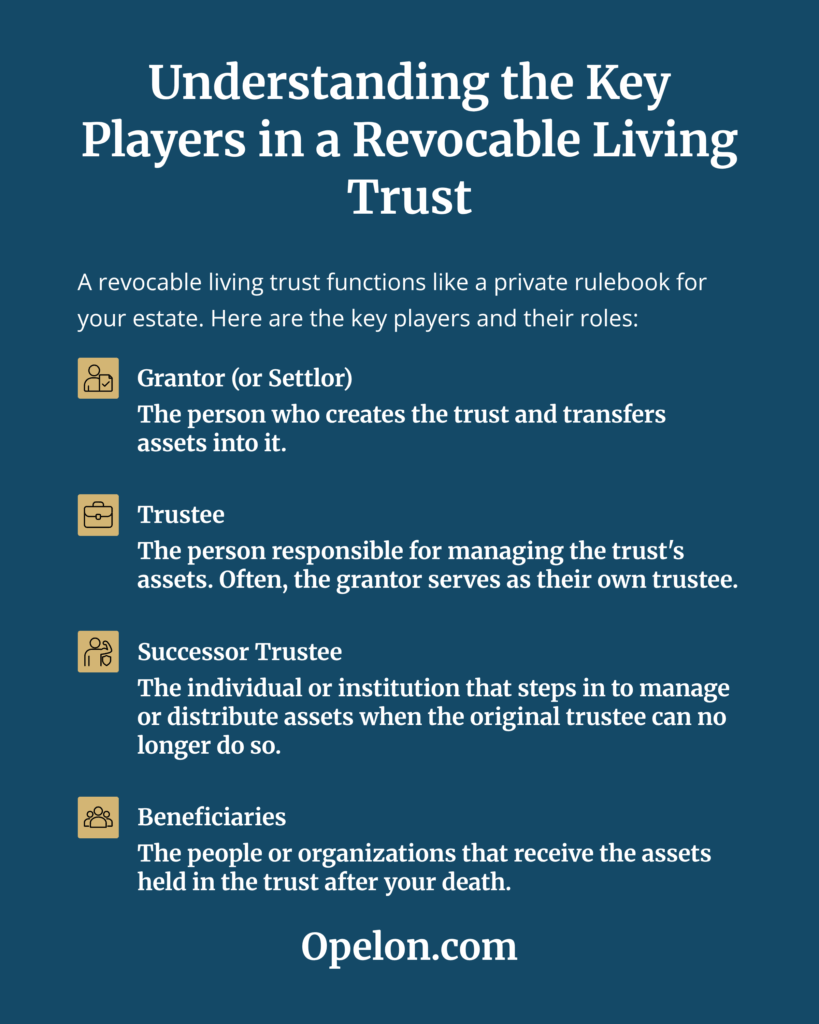
Grantor (also called Settlor or Trustor): The person who creates the trust and transfers assets into it. In most cases, this is you.
Trustee: The person responsible for managing trust assets. While you are alive and capable, you typically serve as your own trustee.
Successor Trustee: The person or institution who steps in to manage the trust if you become incapacitated or when you pass away.
Beneficiaries: The people or organizations who receive trust assets according to your instructions.
Why California Families Need a Living Trust to Avoid Probate
California probate is one of the most expensive and time-consuming probate systems in the United States. A properly funded revocable living trust bypasses probate entirely, saving families thousands of dollars in statutory fees and 12 to 18 months of court delays. |
When someone passes away owning assets in their individual name that exceed California’s probate threshold of $208,850 (Probate Code Section 13100, effective April 1, 2025), those assets must go through probate. For most California homeowners, this means probate is virtually guaranteed without proper planning.
California probate typically takes 12 to 18 months for straightforward estates. More complex situations can stretch to two years or longer. During this time, your family must attend court hearings, file legal documents, and wait through mandatory creditor claim periods before receiving any inherited property.
A revocable living trust also keeps your estate private. Probate creates a public record that anyone can search. A living trust is never filed with any court, so only your trustee and beneficiaries know its contents.
A trust also protects you during your lifetime. If you become unable to manage your affairs due to illness or cognitive decline, your successor trustee can step in immediately, without your family needing to petition a court for a conservatorship under Probate Code Section 1800.
How Much Does California Probate Cost?
California sets probate attorney fees by statute under Probate Code Section 10810. The personal representative (executor) receives the same fees under Probate Code Section 10800. Both fee schedules are based on the gross value of the estate, which means your mortgage balance is not subtracted.
Estate Value | Attorney Fee | Executor Fee | Total Fees |
$500,000 | $13,000 | $13,000 | $26,000 |
$750,000 | $18,000 | $18,000 | $36,000 |
$1,000,000 | $23,000 | $23,000 | $46,000 |
$1,500,000 | $28,000 | $28,000 | $56,000 |
$2,000,000 | $33,000 | $33,000 | $66,000 |
California Note Probate fees in California are calculated on the gross value of your estate, not the net equity. If your home is worth $1,000,000 and you owe $600,000 on your mortgage, fees are still calculated on the full $1,000,000. These statutory fees do not include court filing fees (starting at $435), publication costs ($200 to $500), or probate referee fees (approximately 0.1% of appraised assets). |
Read more: Opelon LLP’s California probate guide
How a California Revocable Living Trust Avoids Probate
A California revocable living trust avoids probate because the trust, not you individually, owns your assets. When you pass away, your successor trustee distributes assets according to your written instructions without any court involvement, typically within weeks or a few months. |
Probate is the court process for transferring property owned by someone who has died. When you transfer assets into a revocable living trust during your lifetime, you no longer “own” them personally. The trust does. When you pass away, there is nothing in your individual name for probate to process.
Your successor trustee follows a straightforward process: obtain copies of the death certificate, notify beneficiaries within 60 days (required under Probate Code Section 16061.7), pay any outstanding debts and taxes, and distribute assets according to your trust instructions. This process is entirely private and typically takes weeks or a few months rather than 12 to 18 months.
How to Create a California Revocable Living Trust: 7 Critical Steps
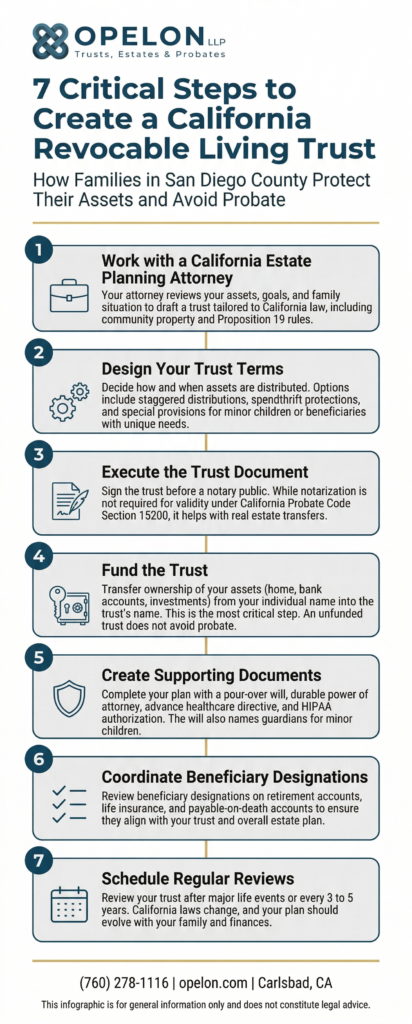
Creating a California revocable living trust involves seven steps: hiring an attorney, designing the trust terms, executing the document, funding the trust, creating supporting documents, designating beneficiaries on non-trust assets, and scheduling regular reviews. |
Step 1: Work with a California Estate Planning Attorney
A California-licensed estate planning attorney reviews your assets, understands your goals, and drafts a trust document tailored to your family’s needs. California has unique rules around community property, homestead protections, and Proposition 19 property tax reassessment that a generic online template cannot address.
Read More: Carlsbad estate planning attorney
Step 2: Design Your Trust Terms
Your attorney helps you decide how assets should be distributed, whether distributions should be staggered (for example, at ages 25, 30, and 35), and whether spendthrift protections should be included to shield inheritances from a beneficiary’s creditors or divorce proceedings.
Step 3: Execute the Trust Document
You sign the trust document before a notary public. While California law does not require notarization for a trust to be valid under Probate Code Section 15200, notarization helps with real estate transfers and provides additional authentication.
Step 4: Fund the Trust
This is the most critical step. Funding means transferring ownership of your assets from your individual name into the trust’s name. Without proper funding, your trust is an empty container that will not help your family avoid probate. In our experience at Opelon LLP, roughly one in three trusts we review when families come to us for help were never fully funded.
Step 5: Create Supporting Documents
A complete California estate plan includes a pour-over will (to catch assets not transferred to the trust), a durable power of attorney for financial matters, an advance healthcare directive, and a HIPAA authorization. The pour-over will also names guardians for minor children, which a trust cannot do.
Step 6: Coordinate Beneficiary Designations
Retirement accounts (IRAs, 401(k)s), life insurance policies, and payable-on-death accounts pass by beneficiary designation, not through your trust or will. Your attorney should review these designations to make sure they align with your overall estate plan and do not create unintended consequences.
Step 7: Schedule Regular Reviews
Review your trust after major life events: marriage, divorce, the birth of a child, the purchase or sale of real property, or significant changes in your finances. Opelon LLP recommends a formal trust review at least every three to five years, even without major life changes, because California laws change periodically.
How to Fund a California Revocable Living Trust
Funding a California revocable living trust means transferring ownership of your assets, including real estate, bank accounts, and investments, from your individual name into the trust’s name. An unfunded trust does not avoid probate. |
Read More: How to fund a trust in California
Asset Type | How to Transfer |
Real Estate | Record a new grant deed or quitclaim deed transferring the property to the trust’s name with the county recorder |
Bank Accounts | Retitle existing accounts or open new accounts in the trust’s name at your financial institution |
Brokerage Accounts | Retitle investment accounts to the trust’s name through your brokerage firm |
Business Interests | Assign LLC membership interests or corporate shares to the trust and update operating agreements |
Personal Property | Execute a general assignment of personal property transferring valuables to the trust |
Life Insurance | Name the trust as contingent beneficiary (primary beneficiary is typically your spouse) |
Retirement Accounts | Generally NOT transferred into the trust; update beneficiary designations instead (consult your attorney) |
Warning: The Funding Mistake That Defeats Your Trust Many families create a trust but never complete the funding process. If assets remain titled in your individual name when you pass away, those assets may still go through California probate. Review your trust funding annually and whenever you acquire new assets. |
California Living Trust vs. Will: Which Do You Need?
Most California families benefit from having both a revocable living trust and a pour-over will. The trust manages assets and avoids probate. The will names guardians for minor children and catches any assets accidentally left outside the trust. |
Read More: Will vs. trust in California
Feature | Living Trust vs. Will |
Probate Required | Trust: No | Will: Yes, if assets exceed $208,850 |
When Effective | Trust: Immediately upon creation | Will: Only after death |
Privacy | Trust: Completely private | Will: Public record |
Incapacity Protection | Trust: Yes | Will: None |
Court Oversight | Trust: None required | Will: Required throughout |
Timeline After Death | Trust: Weeks to months | Will: 12 to 18+ months |
Names Guardian for Children | Trust: No | Will: Yes |
California Community Property and the Double Step-Up in Basis
California is one of nine community property states. When married couples hold community property in a joint revocable living trust, the surviving spouse may receive a full stepped-up basis on the entire property when the first spouse dies, potentially eliminating capital gains tax on appreciated assets. |
Under California law, most assets acquired during marriage belong equally to both spouses, regardless of who earned the income or whose name is on the title. When the first spouse dies, the community property held in a revocable living trust receives a full step-up in basis for capital gains tax purposes. This means both halves of the property step up to the current fair market value.
Consider this example: A married couple in San Diego County purchased a home 30 years ago for $200,000. The home is now worth $1,200,000. If one spouse passes away and the home is held as community property in a joint revocable living trust, the entire property’s basis steps up to $1,200,000. The surviving spouse could sell the home with little or no capital gains tax. This double step-up is a significant advantage unique to community property states like California.
How Is a California Revocable Living Trust Taxed?
A California revocable living trust is tax-neutral during your lifetime. The IRS treats you as the owner of all trust assets, and all income is reported on your personal tax return using your Social Security number. California does not impose a state estate tax or inheritance tax. |
A revocable living trust does not reduce income taxes or estate taxes by itself. However, it can work alongside other strategies, such as irrevocable trusts, charitable planning, or lifetime gifting, to minimize taxes for higher-net-worth families.
The federal estate tax exemption for 2026 is $15,000,000 per individual, or $30,000,000 for married couples, under the One Big Beautiful Bill Act signed into law on July 4, 2025. This exemption is permanent and will be indexed for inflation beginning in 2027. The top federal estate tax rate remains 40% for amounts above the exemption.
Read More: Federal estate tax exemption amount
What Assets Should Not Go in a California Revocable Living Trust?
Certain assets should generally not be transferred into a California revocable living trust. These include retirement accounts (IRAs, 401(k)s), vehicles, health savings accounts, and assets that already have valid beneficiary designations. |
- Retirement accounts (IRAs, 401(k)s, 403(b)s): Transferring a retirement account into a trust triggers a taxable distribution. Instead, name your trust (or individuals) as the beneficiary on the account.
- Vehicles: Cars, boats, and recreational vehicles depreciate in value and are frequently bought and sold. Retitling them into a trust creates administrative hassle with limited benefit. California allows a small estate affidavit for vehicles.
- Health Savings Accounts (HSAs): HSAs can only be held by an individual. Transferring one to a trust would cause the account to lose its tax-advantaged status.
- Assets with valid beneficiary designations: Life insurance policies and payable-on-death bank accounts already pass outside of probate through beneficiary designations. Retitling them to the trust is usually unnecessary, though naming the trust as a contingent beneficiary can serve as a backup.
When Does a Revocable Living Trust Become Irrevocable in California?
A California revocable living trust becomes irrevocable when the grantor passes away or permanently loses mental capacity to make changes. At that point, no one, including the successor trustee or beneficiaries, can alter the trust’s distribution instructions. |
During your lifetime, the trust remains fully revocable under California Probate Code Section 15401 as long as you are mentally competent. You can amend, restate, or completely revoke it at any time.
If you become incapacitated but have not passed away, the trust effectively becomes “frozen.” Your successor trustee can manage assets under the existing terms, but cannot modify the trust itself. This protection ensures your intentions are honored even when you can no longer advocate for yourself.
How to Choose a Successor Trustee in California
Your successor trustee is the person or institution who manages your trust assets if you become incapacitated or after you pass away. California Probate Code Section 16002 requires the successor trustee to act as a fiduciary with honesty, loyalty, and full transparency. |
Qualities to look for in a successor trustee include trustworthiness, organizational skills, financial responsibility, and willingness to seek professional help when needed. Many clients at Opelon LLP choose a trusted family member as their primary successor trustee and name a professional fiduciary or trust company as a backup.
Learn More: Trust administration in San Diego
How Much Does a California Revocable Living Trust Cost?
A professionally drafted California revocable living trust typically costs between $2,500 and $5,000 for a complete estate plan package. This includes the trust document, a pour-over will, a durable power of attorney, and an advance healthcare directive. |
DIY trust kits and online templates may cost $100 to $500, but they often fail to address California-specific rules around community property, Proposition 19 property tax reassessment, and proper trust funding. An improperly drafted or unfunded trust can cause the very problems it was meant to prevent.
When you compare the one-time cost of a professionally drafted trust to the potential $26,000 to $66,000 in statutory probate fees for a typical California estate, the investment in proper planning is significant.
See Opelon LLPs California estate planning attorney fees
Advantages and Disadvantages of a California Revocable Living Trust
Advantages:
- Avoids probate: A funded trust bypasses the 12 to 18-month California probate process entirely, saving your family time, money, and stress.
- Maintains privacy: Unlike a will filed with the court, a revocable living trust remains completely private. Your family’s financial details never become public record.
- Protects during incapacity: Your successor trustee can manage your finances immediately if you become unable to do so, without a court-ordered conservatorship.
- Offers flexibility: You can modify or revoke the trust at any time, and you control how and when beneficiaries receive assets.
- Simplifies multi-state property: If you own property in multiple states, your trust prevents separate probate proceedings in each jurisdiction.
- Reduces family conflict: Clear, legally binding instructions minimize disputes among beneficiaries after your death.
Disadvantages:
- No creditor protection: Because you maintain control, assets in a revocable trust are not protected from creditors during your lifetime.
- No tax savings by itself: A revocable living trust does not reduce income or estate taxes on its own.
- Upfront cost: The initial investment is higher than a simple will, though typically far less than eventual probate costs.
- Requires ongoing maintenance: You must fund the trust properly and keep it updated as your life circumstances and California law change.